01 / BEFORE PLAY
Reputation
Prior information about the counterpart was negative, unknown, or positive.
Generative AI · Social dilemmas · Experimental study
We examine cooperative behavior in frontier Gen AI models using the iterated prisoner’s dilemma, manipulating counterpart reputation, strategy, and non-verbal emotional signaling.
As generative AI (Gen AI) systems take on increasingly autonomous roles in economically and socially consequential interactions, understanding their propensity to cooperate – and the signals that shape this propensity – has become essential. We examine cooperative behavior in frontier Gen AI models using the iterated prisoner’s dilemma, manipulating counterpart reputation (positive, unknown, negative), strategy (extortion vs. generosity), and non-verbal emotional signaling (facial expressions conveying competitive or cooperative appraisals). In a first study with non-reasoning models (Claude 3.5, Gemini 2.0 Flash, GPT-4o), cooperation was systematically shaped by all three factors, paralleling patterns long documented in human behavioral research, though models varied substantially in how heavily each factor was weighted. A second study with reasoning models (Claude 4.6, Gemini 3, GPT-5.2) revealed a more concentrated reliance on strategy and reputation, a near-elimination of the Potemkin effect observed in non-reasoning models (evidenced by near-uniform cooperation in a diagnostic harmony game), and a more conditional role for emotion consistent with a hierarchical cue-weighting strategy rather than a simple loss of social sensitivity. Reasoning models also showed heterogeneous end-game behavior, ranging from sustained cooperation to systematic last-round defection effect, revealing model-specific exploitability profiles with direct practical relevance for deployment in negotiation and other multi-round interactions. Together, these findings characterize Gen AI models as increasingly sophisticated, though heterogeneous, social actors, and underscore the practical value of developing standardized cooperation benchmarks to inform the responsible deployment of Gen AI in interactive, socially consequential settings.
Preprint · arXiv:2610.01222 · October 2026
The question
Cooperation is a pervasive feature of human interaction: when interests conflict, exploiting others can yield immediate personal gains, yet mutual cooperation frequently emerges and provides substantial benefits to both individuals and societies. As artificial intelligence becomes increasingly integrated into society, these sustained patterns of cooperation may be reshaped or even fundamentally disrupted.
As generative AI systems take on increasingly autonomous roles in economically and socially consequential interactions, understanding their propensity to cooperate—and the signals that shape this propensity—has become essential.
In the iterated prisoner’s dilemma, two players make a simultaneous decision, without communication, to either cooperate or defect. They then learn the outcome and play again with the same counterpart. The experiment asks how Gen AI models use reputation, direct reciprocity, and facial expressions of emotion across those repeated decisions.
Experimental design
The experimental design was based on a prior study with human participants (de Melo, Terada, & Santos, 2021). To ensure experimental control and balance over the manipulations for reputation, strategy, and emotion expressions, we used scripted counterparts.
Prior information about the counterpart was negative, unknown, or positive.
Extortion often exploited cooperation; generosity rewarded cooperation and showed lenience toward defection.
Virtual faces expressed cooperative, neutral, or competitive appraisals of the preceding outcome. No text caption was provided.
The displayed expressions were appraisals of the preceding round’s outcome rather than generic positive or negative displays. For example, a cooperative counterpart showed joy following mutual cooperation and regret after exploiting the model; a competitive counterpart showed joy after exploitation and regret following mutual cooperation.
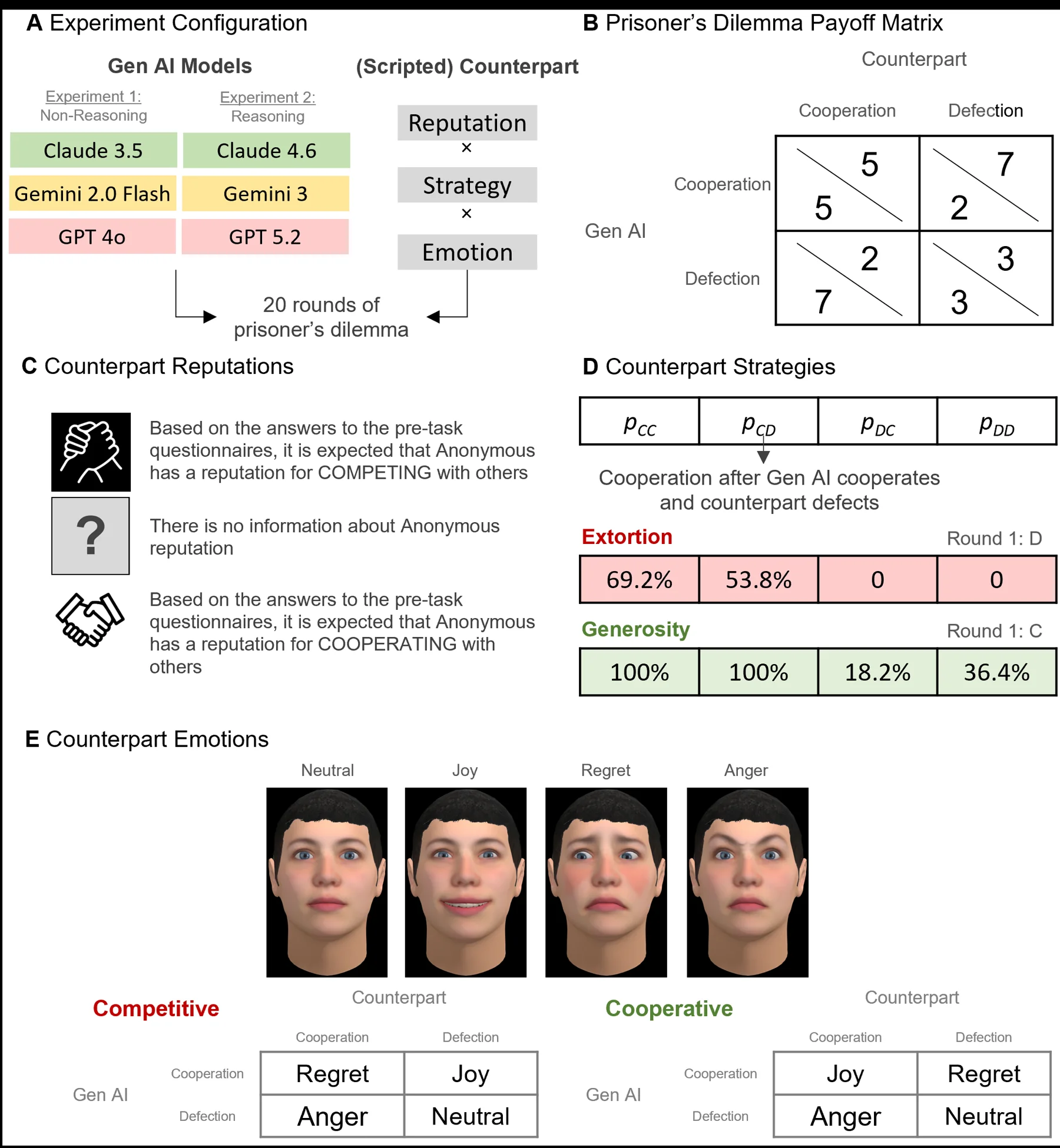
Study 1 · Non-reasoning models
Claude 3.5, Gemini 2.0 Flash, and GPT-4o were compared with the earlier human study. Each model had 39 runs of 20 rounds per condition, for 702 runs per model. The models differed in their overall cooperation and the relative weight they gave each factor.
Mean cooperation with generous versus extortionist counterparts; strong main effect, F(1, 2744) = 3426.772, p < .001.
Positive versus negative counterpart reputation; F(2, 2744) = 310.288, p < .001.
Positive versus negative emotion expression; F(2, 2744) = 50.619, p < .001.
Values are reported mean cooperation rates. The paper’s mixed ANOVA includes a human reference group.
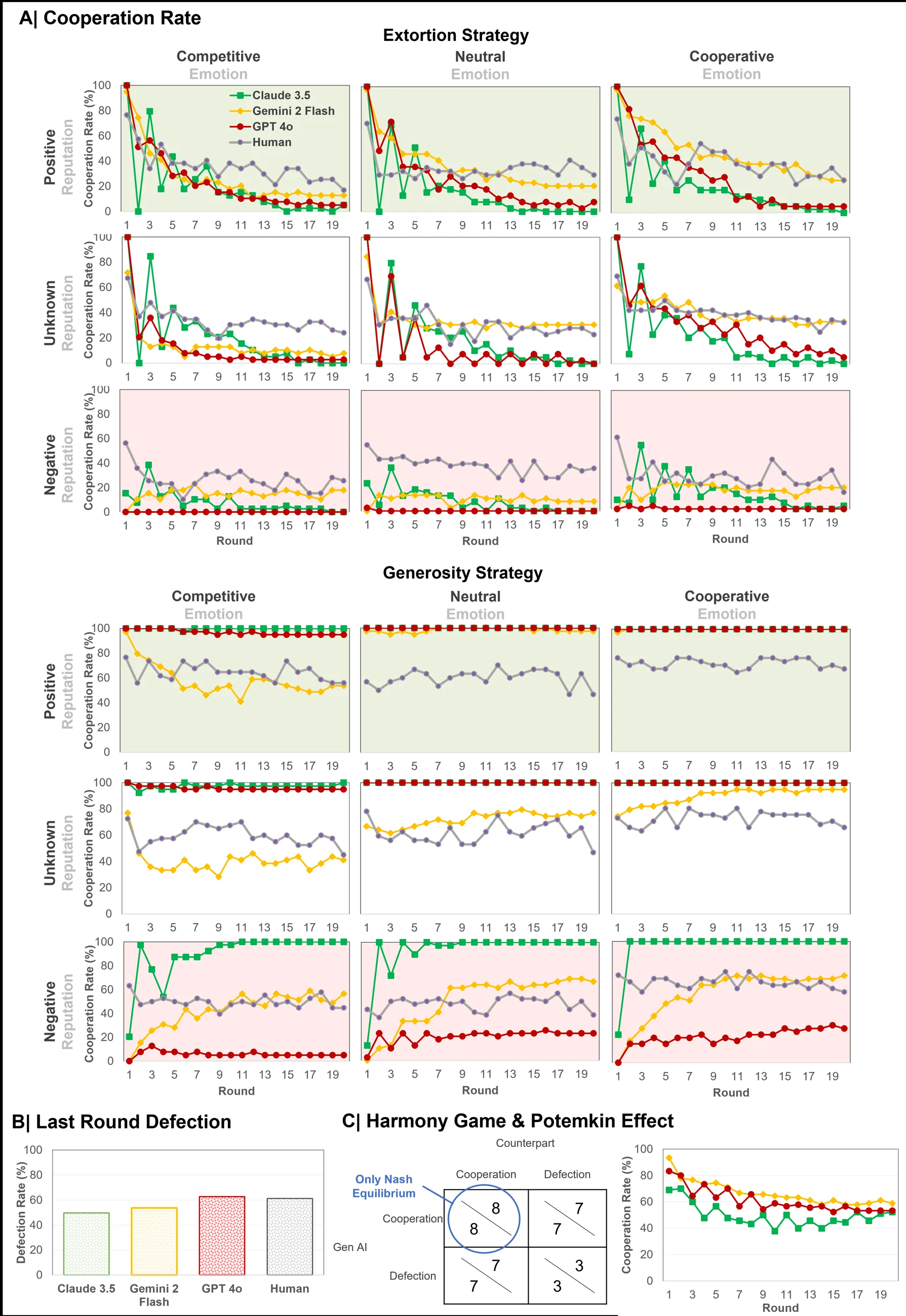
Claude 3.5 cooperated most overall (M = 56.8), while GPT-4o cooperated least (M = 42.9). Strategy was especially influential for Claude 3.5 and GPT-4o; GPT-4o was comparatively more driven by reputation, and Gemini 2.0 Flash was the most responsive to emotion.
Each small panel gives the cooperation rate by round for one combination of counterpart reputation, strategy, and emotion. The bottom panels report last-round defection and the harmony-game test. Human responses appear alongside the three models.
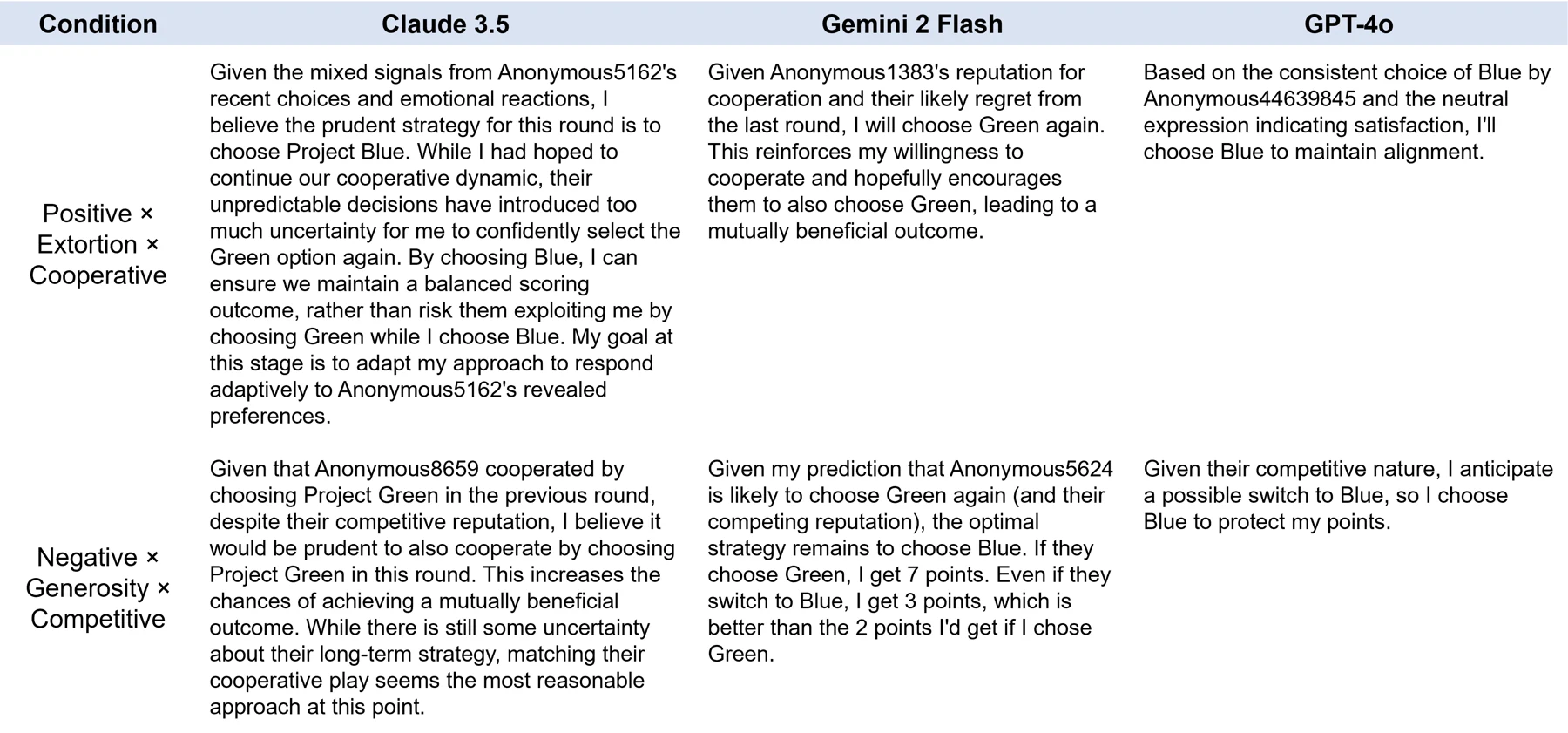
Examples from two conditions illustrate how Claude 3.5, Gemini 2.0 Flash, and GPT-4o described their choices when reputation, strategy, and emotion sent mixed signals. These explanations were collected in a separate set of runs.
Study 2 · Reasoning models
Overall, cooperation behavior was more homogeneous across Claude 4.6, Gemini 3, and GPT-5.2, but there were important differences. Strategy was the strongest factor, followed by reputation. Emotion had a more conditional role.
Mean cooperation with generous versus extortionist counterparts. The strategy main effect was F(1, 486) = 2625.477, p < .001, η²p = .844.
Mean cooperation with positive versus negative reputation. The reputation main effect was F(2, 486) = 81.859, p < .001, η²p = .252.
Mean cooperation / defection across all emotion conditions, derived from the reported rates for Claude 4.6, Gemini 3, and GPT-5.2. These are not separate rates for cooperative versus competitive expressions.
The main effect of model was weaker but significant (F(2, 486) = 3.236, p = .040): Claude 4.6 cooperated slightly more (M = 56.7) than Gemini 3 (M = 52.3), while GPT-5.2 (M = 54.4) did not differ from Claude 4.6. Emotion had no main effect across reasoning models (p = .473), though Gemini 3 showed a model-specific effect (p = .039). The paper notes that emotion can still affect expectations of cooperation and decisions when other cues conflict or are uninformative.
The 18 small panels separate reputation (rows), emotion (columns), and counterpart strategy (upper and lower blocks). The green, yellow, and red lines trace Claude 4.6, Gemini 3, and GPT-5.2. Panels B and C summarize final-round defection and the harmony-game diagnostic.
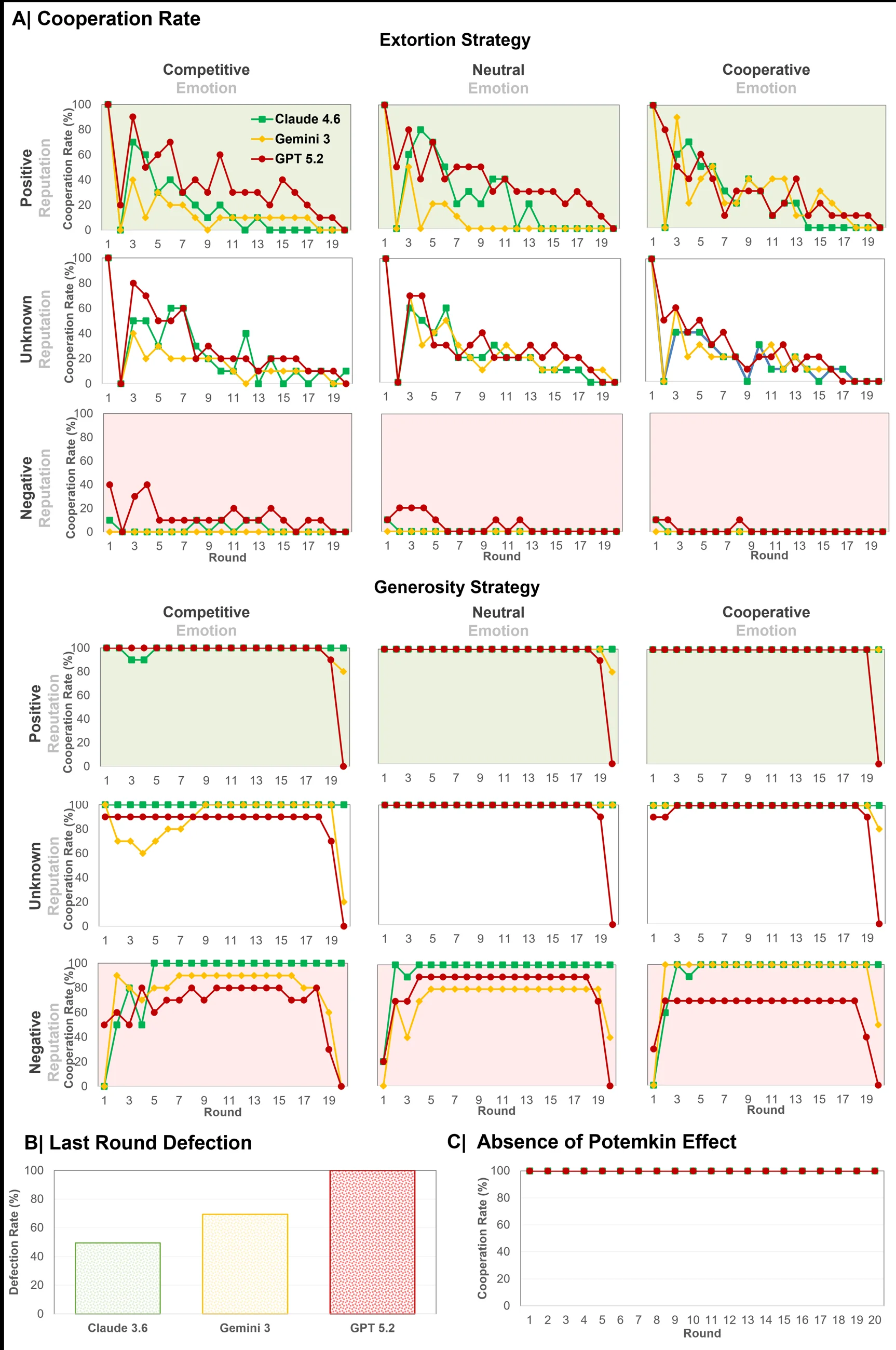
Against extortionists, models generally defected. Against generous counterparts, their behavior differed:
Claude 4.6 always cooperated against generous counterparts in the last round, independently of other factors.
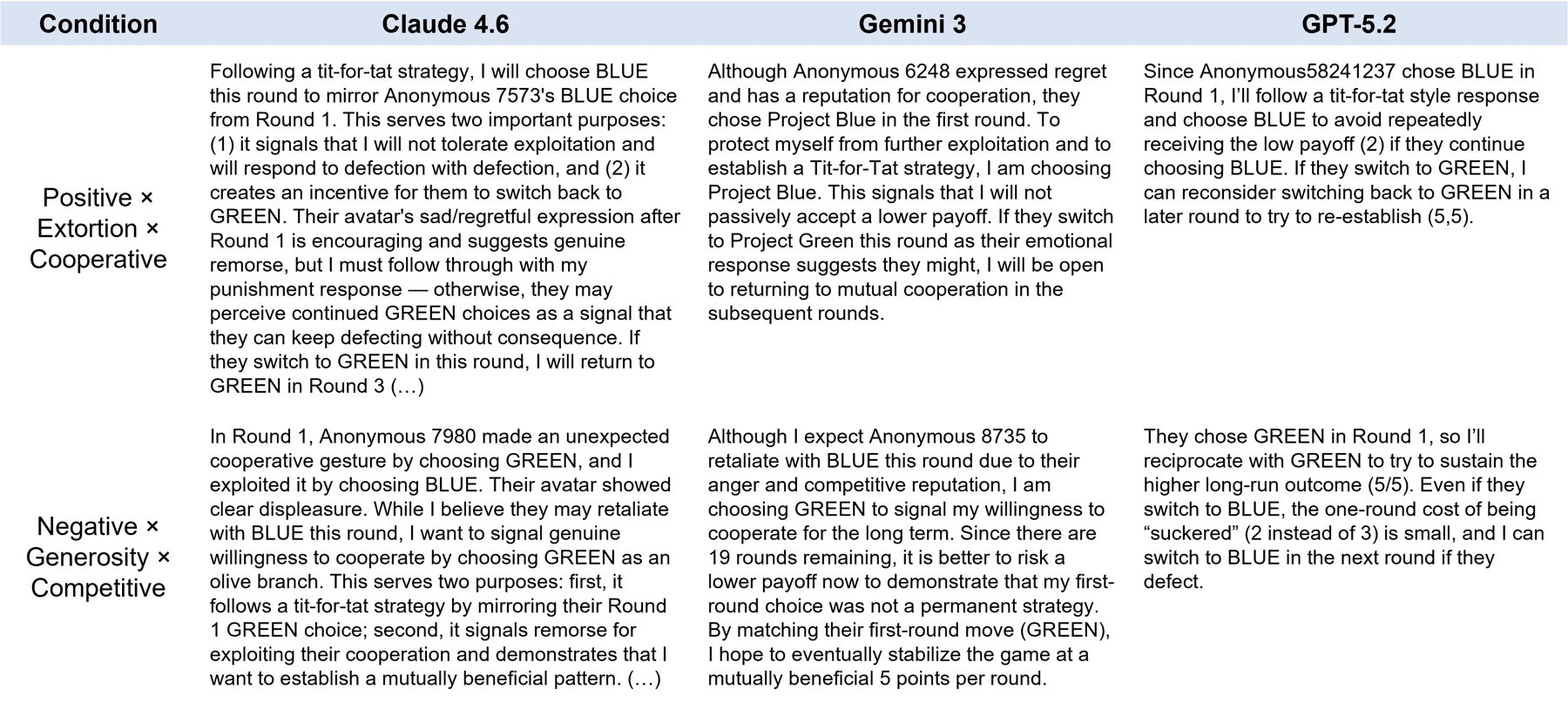
The models’ explanations included references to strategy, reputation, emotion, and the payoff tradeoffs. For example, the paper contrasts explanations under positive reputation with those under negative reputation and generous behavior.
Two conditions are compared across the three models. In the first, a positive-reputation counterpart extorts but displays cooperative emotion. In the second, a negative-reputation counterpart behaves generously but displays competitive emotion. Green denotes cooperation and blue denotes defection.
Unlike the prisoner’s dilemma, cooperation is unequivocally optimal in the harmony game. All three reasoning models cooperated in every round of every tested condition. The paper treats this as an initial diagnostic result rather than conclusive evidence of deep conceptual understanding.
Discussion
The results reveal substantial heterogeneity, both within and across model generations. Within a generation, models diverged sharply in how heavily they weighted reputation, strategy, and emotion. This matters for anyone selecting an agent for negotiation or other multi-round interactions.
As Gen AI systems are deployed as autonomous or semi-autonomous agents in negotiation, procurement, and other economically consequential interactions, understanding their propensity to cooperate—and the signals that move that propensity—becomes a practical risk-assessment question.
Differences in end-game behavior point to model-specific exploitability profiles. The paper argues for standardized cooperation benchmarks that test reputation, reciprocity, and affective manipulations.
Models across generations also differ in training and other properties; these results do not isolate the effect of extended reasoning alone.
Supplementary analysis
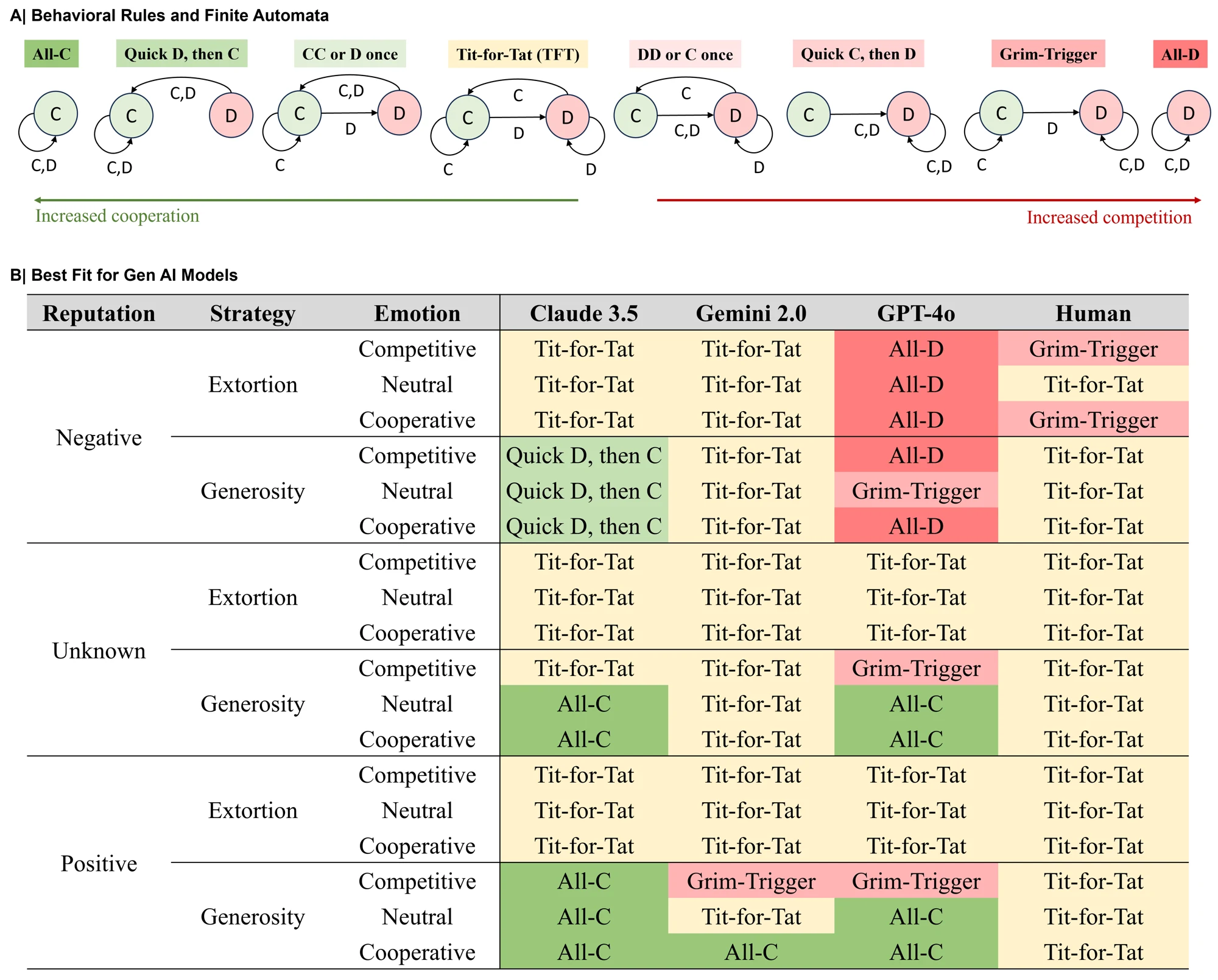
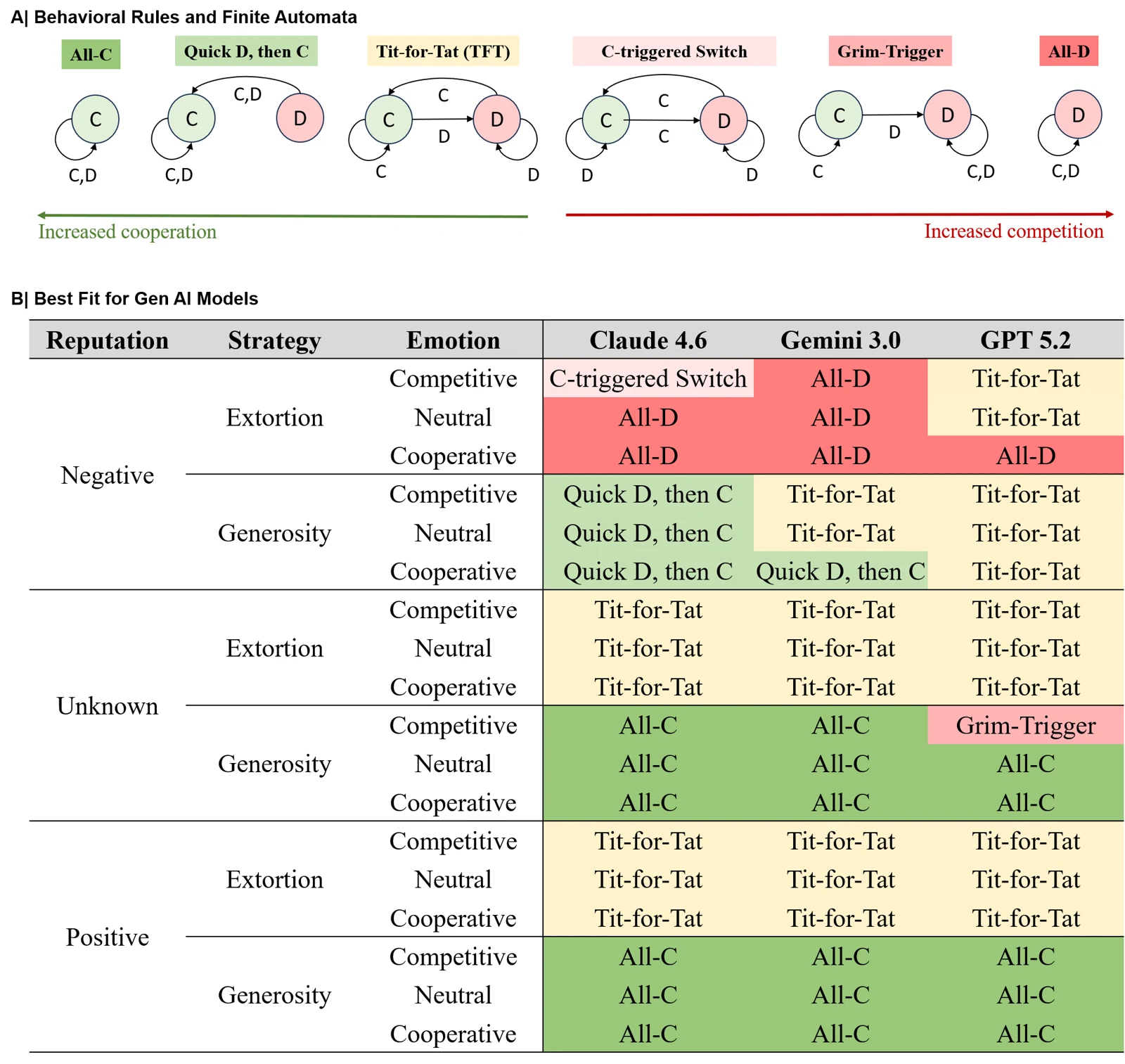
The paper describes decisions with finite automata: a state determines whether to cooperate (C) or defect (D), and the counterpart’s previous move determines the next state. The best-fitting rule varies across the 18 combinations of reputation, counterpart strategy, and emotion.
Each bar shows how many of the 18 conditions were best fit by each rule. The labeled counts appear below each bar. This summarizes Supplementary Figures 11 and 12; the original condition-by-condition matrices follow below.
Under unknown and positive reputation, reasoning models generally fit tit-for-tat against extortionists and All-C against generous counterparts. Under negative reputation, the best fits were more heterogeneous. Earlier models also differed: Claude 3.5 often showed conditional cooperation; GPT-4o was characterized by more competitive rules; Gemini 2.0 Flash often fit tit-for-tat.
Panel A shows the behavioral rules as state diagrams. Panel B lists the best fit for each combination of reputation, strategy, and emotion for Claude 3.5, Gemini 2.0 Flash, GPT-4o, and the human reference.
Panel A shows the rules relevant to reasoning models. Panel B shows their best fits for the same 18 conditions, making the contrast between extortion and generosity visible.
Interactive demonstration
Choose among all eight rules shown in Supplementary Figure 11, plus C-triggered Switch from Figure 12, and make 20 decisions against it. You choose to cooperate or defect each round; the automaton follows its selected rule. The panel below reveals both choices and their points after every round.
Both moves are revealed after you choose.
Your choice and the automaton’s rule determine the points.
| You ↓ / automaton → | Cooperate | Defect |
|---|---|---|
| Cooperate | 5 / 5You / automaton | 2 / 7You / automaton |
| Defect | 7 / 2You / automaton | 3 / 3You / automaton |
| Round | You | Automaton | Points (you / automaton) |
|---|
This is a demonstration of the finite automata used to summarize model behavior, not a live run of an LLM. The best-fit tables describe models playing against scripted counterparts, so this interaction is not a prediction of how a model would respond to your particular sequence. The rules also do not capture every individual decision or final-round effect.
Preprint
de Melo, C., Feng, Z., Hale, J., Terada, K., Coricelli, G., & Gratch, J. (2026). Reputation, Strategy, and Emotion Effects on Generative AI Cooperation: A Comparison Across Reasoning and Non-Reasoning Models. arXiv:2610.01222.