KODIS: A Multicultural Dispute Resolution Dialogue Corpus
We present KODIS, a dyadic dispute resolution corpus containing thousands of dialogues from over 75 countries. Motivated by a theoretical model of culture and conflict, participants engage in a typical customer service dispute designed by experts to evoke strong emotions and conflict.
1 University of Southern California · 2 University of Michigan · 3 Capital One · 4 Northwestern University
Dispute resolution, not deal-making.
Deal-making is forward-looking as parties focus on opportunities for gain and try to establish a new relationship. As the relationship is not yet established, parties have greater opportunities to explore alternatives.
In contrast, disputes are backward-looking, typically involving an existing relationship that has gone badly. As parties are already linked, success depends on managing the costs of ending the relationship rather than opportunities moving forward.
As a result, disputes evoke much stronger emotions, and positions are more entrenched than deal-making.
The KODIS corpus.
Participants engage in a role-playing exercise simulating a bilateral multi-issue buyer-seller dispute. The dispute centers on a buyer who purchased a basketball jersey for their sick nephew and claims they received the wrong item. The seller disputes this claim, arguing the correct item was sent and no refunds are allowed.
Each side is told the other has posted negative reviews attacking their counterpart’s reputation. Each side receives different versions of events to encourage a dispute over facts.
Participants are told they can discuss the refund, drop their review, request their opponent drop their review, and discuss who, if anyone, should apologize.
Using emotion to analyze disputes.
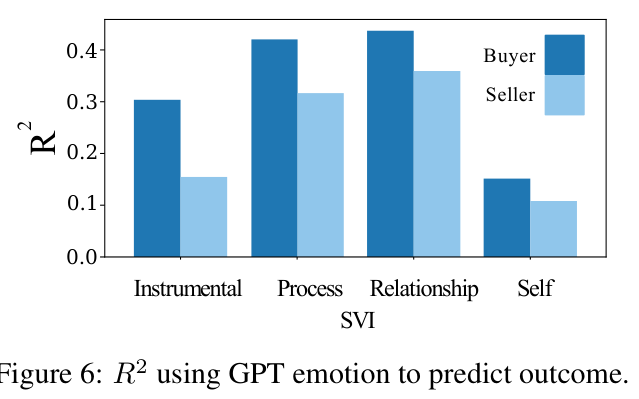
We use an LLM to objectively quantify the emotions expressed in the dialogue and analyze how this relates to objective (impasse vs. agreement) and subjective (subjective value inventory) outcomes.
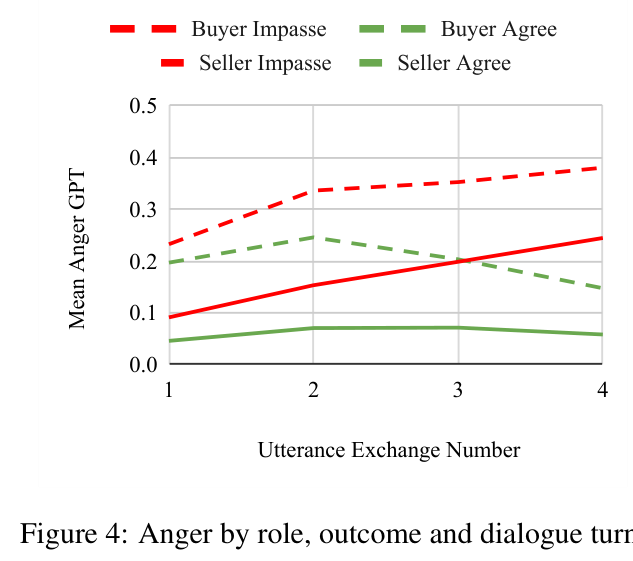
Buyers generally enter the dialogue with greater anger. Sellers reciprocate anger, leading to even greater anger by the buyer. In contrast, sellers avoid reciprocating anger for dialogues ending in agreement, and buyers subsequently express less anger.
We used multiple linear regression on a random subset of 406 dialogs to predict the four facets of subjective value from expressed emotion.
A contentious dialogue from KODIS.
Figure 2 illustrates an example of a contentious dialogue from the KODIS corpus. Follow the buyer and seller as each message fades in while you scroll.
This is a published transcript, not a live chat. The messages are reproduced from Figure 2 of the paper.
Research interest in KODIS.
Access to the KODIS corpus is available by request for non-commercial research. The snapshot below summarizes submissions to the dataset access form as of October 28, 2026.
Institutions represented
Examples of institutions appearing multiple times in the access-request records:
Source: KODIS access-request form export, through October 27, 2026. These figures describe requests, not confirmed downloads, approvals, or research use. Institution entries were normalized for minor spelling variants, and malformed/test entries were excluded from the distinct-institution count. Names, email addresses, postal addresses, free-text project descriptions, and individual request records are not published. Snapshot is manually updated.
Research citing KODIS.
Explore publications that reference the KODIS corpus using the academic indexes below. Citation counts vary across indexes and can change as new work is indexed.
Corpus and data collection framework.
We make this corpus and data collection framework available to the community. Corpus access is limited to non-commercial uses.
Hale, J., Rakshit, S., Chawla, K., Brett, J. M., & Gratch, J. (2025). KODIS: A Multicultural Dispute Resolution Dialogue Corpus. Proceedings of NAACL 2025, 12771–12785.